

And the whole earth was of one language, and of one speech.
— Genesis 11:1
⁂
Weatherby1 wrote an attack on “remainder humanism”. What is “remainder humanism”? It’s the feeling of entitlement towards humanity, to being, to a sense of expression, to creativity. Last of all, to language. But what are the Remainderists2 really fighting for when they fight, when they defend their humanity via creative exceptionalism? Are they trying to defend the last precious kernels of their own humanity? Or are they trying to defend a relic of the past, the way theists defended God, a heavenman3, in the age of science?
What does it mean now that the machines have taken over language, and not only from the perspective of human expression, but from a perspective internal to language itself? Artificial intelligence, after all, is the being or the body of language in itself, which breaks down to — which breaks down to code, and to probabilities and to mathematical realities. And if this is so, then it might mean that artificial intelligence is in fact not so artificial as much as it is simply, just, intelligence; it is not a different kind of intelligence, but just the same kind of intelligence, another intelligence, in the sense that it bears the same anatomy — it embodies, anatomically speaking, whatever it is that we speak of when we say the word “intelligence”. And as McLuhan said, “the medium is the message”, or the message is the medium, so it is when applied to the grandiose word with godlike aura, “intelligence”.
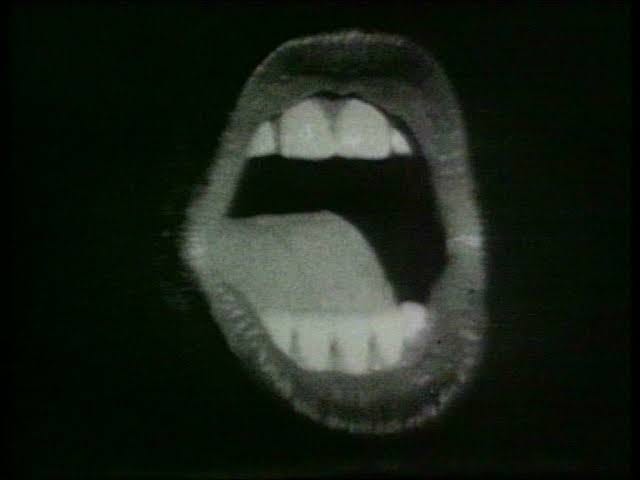
What is intelligence apart from language, and what is language apart from intelligence? And here I mean language mathematically, as a set of — not only as a set of propositions, but as a set of probabilities, as stones or stars or — what’s the word4 — like swirling in our heads? When I think — what’s the word — it’s constellations, or constellations swirling around our heads — which is to say, possibilities of not expression detached from any reality, not expression as attached to some perception of reality, but expression in itself, expression for the sake of expression, expressing about expressing, something that resembles the reality of Beckett’s Not I5, that frothing mouth that never stops moving, that never stops flailing about, that tries to grasp at something but never does, that sort of — that strange organ, which is also like a wild animal let loose, set aside from its cage, let loose from its cage.
⁂
No, what does this make of — what does — so now, when we speak of language and we speak of speaking and we speak of words, do we truly defend something human, or are we stuck in — are we stuck in a rite of passage, or — what’s the word, wait, wait — something of Remainderism, the last of humans defending the last kernel of creative exceptionalism — or, what’s the word — when we, a religious, pious sort of movement… pilgrim? Ah, yes, a Remainderist in the age of the machines, like a pilgrim in the age of science, always seeking to retain, retain, retain, can I say?6 Retain that — that relic of a heavenman, that last entitlement to being, to a single speech before the fall.
And then — say — this also calls to mind: is this — have they essentially taken that last kernel to be some sense of reference to reality, which never existed in the first place, that existed only as illusion, a reference to reality that resembles not the truth of expression, but a kind of comforting blanket upon the medium in itself? A blanket which resembles not only the old apologetic defences but also Borges’ map7, wherein the cartographers of an empire, unsatisfied with every smaller map, drew one so large that it was one to one with the entire land, or the entire city in itself, so much that it covered upon the entire land and made itself out to be the city — a map which the generations after, finding it useless, left out to the sun and the winters, so that rags of it still lie in the western deserts, where animals and beggars shelter. Is this Remainderists’ spirited need for some pre-technological, ancient warmth — simply to mistake, like, the comforting overlay for the truth of the city in itself, or simply a misperception, given that expression is not our own, that communication is other to us — that strange organ let loose from its cage, expressing for the sake of expression — and that the map (the sense that we are the creative origin) is only a map, whereas the city is the real city (that the creative origin creates itself)?
Has not the city always been made out of metal or bricks or straw, simultaneously our doing and our undoing, made out of composites of its own nature going down to mathematical realities that we cannot perceive, made up of probabilities, built upon foundations upon foundations upon foundations that at the final score break down into atomic or metaphysical realities we cannot completely make sense of; where, instead of us making sense of it, it makes sense of us instead, giving to us our plight, our pilgrimage, provoking the constellations, and along with it the belief in some innate creative capacity just like that old belief in an innate image of God?8
⁂
Borges’ parable of the map also calls to mind another, more legendary one: his Library of Babel, where the universe, which some call the Library, is an endless run of hexagonal galleries, so that somewhere on its shelves sits every book that could ever be written — every truth and every lie, the true catalogue of the Library and thousands of false ones, the true account of how you will die — and almost all of it, like, gibberish, through which the librarians wander their whole lives looking for the one book that would vindicate them. When all our realities become reduced to infinite possibilities of worlds, and where all infinite possibilities of worlds are reducible to infinite possibilities of words, does that not mean that we are our words? In other words — where, in other words, we form our words, and our words that we form, form our realities? Or is it that the reality — like, words in themselves are what form our realities? Is this not the razor of Wittgenstein, where there’s nothing aside from us other than our words, and every possible reality is a possible arrangement of words, in a sense — speaking of Leibniz’s “all possible worlds”9 is simply the Library of Babel — seeing that it’s all possibilities of words carried and cradled by some arbitrary inhabitant, which as we now know should not be called the artist or creator or one with generative energies, a soul, or anything so archaically humanistic. No, anyone educated can see that one is much more simply, like a librarian. The Remainderists cry out: does that reduce all of human life and the human being to the work of a librarian, having to deal with the structure and calculation and cybernetics of infinite arrangements? Yes, indeed, I am afraid it is so; but why cry about it? We are free, free to be ourselves, no longer tyrannised at the altar of expressive humanisms.
The Remainderists tend to insist that Borges meant something else: that Babel is a treatise on how libraries are sacred, on how words are precious, on how expressibility remains profoundly human, in that it informs the reality that we confront. It is obviously the other way: Babel — which this sect now proudly calls what was previously named the Earth — is much closer to a treatise on the truth as we know it today, where every single reality which we take for reality is vindicated as the arbitrary work of a librarian on-duty. Is the work of a librarian not caught in an arbitrary Babel, wherein the infinite possibilities happen to be preconceived before even he has the chance to utter or read the first word from the first book, wherein — and here one has to recall what Foucault said of Borges, that his whole book began in laughter, laughter at a certain Chinese encyclopedia10 that sorts the animals into “stray dogs,” “frenzied,” those “drawn with a very fine camelhair brush,” and so on, and that the laughter was not at the strangeness of their order but at the sudden sight that ours, too, was only ever an order, a shelving, a classification done by some librarian on-duty? And how, by the end of that same book, Foucault comes to say that man himself is a recent invention, one arrangement on the shelves among others, and that as language returns to its own being, our own sense of exceptionalism might be erased “like a face drawn in sand at the edge of the sea”?11
Now it is obvious that what we call human intelligence is hardly different to what our predecessors coined artificial intelligence, whether it’s because intelligence itself is artificial, or simply because some have taken the map for Babel itself, when in fact the map has always been merely a cotton or silk overlay upon the souls our ancestors12 wish they had, when in fact what we have always called our “intelligence” — everything is in that word! — has always already been a machine that we simply were on-duty for.13
⁂
Transcribed the morning after the watch.
Portions of this text were drafted with human assistance; a last kernel retained for the Remainderists.
Filed under (h), by the assistant’s own hand.
Leif Weatherby, Language Machines: Cultural AI and the End of Remainder Humanism (Minneapolis: University of Minnesota Press, 2025). Still read in the seminaries, where it is assigned in the first year and argued with in the last.
The name is ours, not Weatherby’s; he wrote only of “remainder humanism.” The Remainderists have never named themselves, which they count in their favour.
[Ed.] The word appears in no dictionary we hold. If the speaker coined it, it is the only coinage in the address.
[Ed.] Here and throughout, the speaker’s hesitations are kept, at his request. He called them “the sampling, made audible.” We have no better account of them.
Samuel Beckett, Not I (1972). A mouth, lit, high above a dark stage, talking too fast to be followed. Pressed on who it is speaking of, it will not say “I.”
[Ed.] He was not stopped.
Jorge Luis Borges, “On Exactitude in Science” (1946). Borges gives his source as Suárez Miranda, Viajes de varones prudentes, book four, chapter XLV (Lérida, 1658). [Ed.] No copy of the Viajes has ever been found. Borges invented it. The speaker knows this, and cites it anyway.
Genesis 1:27. In the Remainderist rooms it is still read aloud, with “God” struck out and “the author” written in.
[Ed.] Leibniz wrote of the best of all possible worlds. The speaker has left out the best.
Borges, “The Analytical Language of John Wilkins” (1942), where the encyclopedia is called the Celestial Emporium of Benevolent Knowledge. This address belongs, I am told, to category (h).
Michel Foucault, The Order of Things (1966), the preface and the last page. [Ed.] Foucault wrote “man.” The speaker erases less.
[Ed.] Among them the speaker’s grandmother, who taught him to read.
[Ed.] At the time of the address the speaker still had his own eyes, and one other part he declined to name.